new: v0.3 — kubernetes-native sandboxes and the multi-user control plane. read the changelog ›

A control plane that answers, afterwards, exactly what an agent did — and why it was allowed to.

fluidbox runs underneath agent harnesses, not instead of them. You register versioned agents; it gives every run an isolated sandbox, a policy gate, human approvals, budgets, and an append-only record.

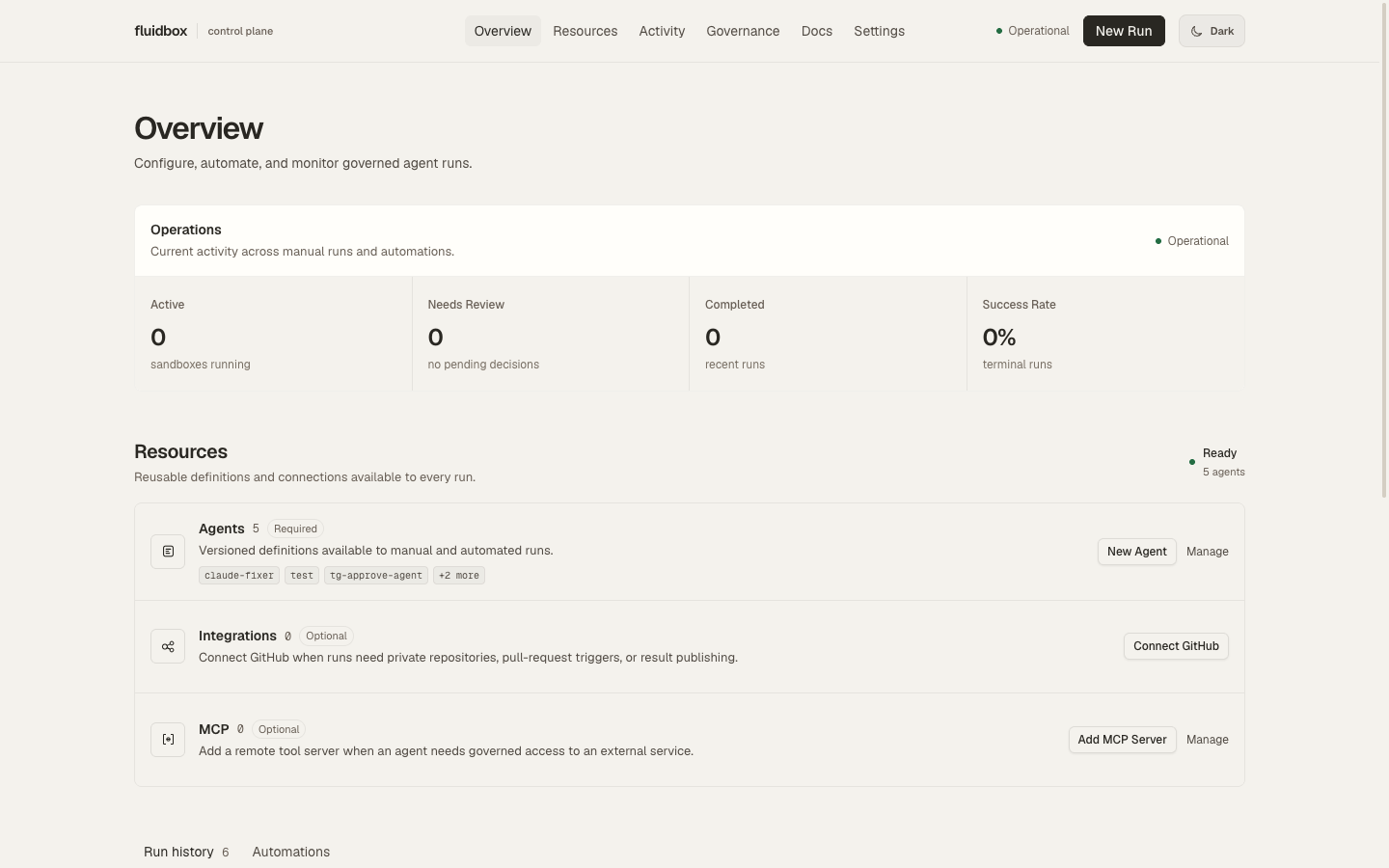
The fluidbox dashboard overview: operations counters for active sandboxes, runs needing review, and completions; the agent, integration, and MCP resource lists; and run history.

A capture of the shipped product, not a mockup.

how a run flows

Six stages, one immutable record.

01

Create — the RunSpec freezes

Dashboard, CLI, API trigger, webhook, or schedule — every entry point converges on one code path that freezes an immutable specification: model, system prompt, task, a full policy snapshot, budgets, the exact tool surface, and who invoked it. Nothing that governs the run can change afterwards.

02

Initialize — the workspace is prepared outside

The credentialed git fetch or copy happens control-plane-side, before the agent exists. The sandbox will only ever see a bind-mounted copy at /workspace; the original repository is never touched.

03

Provision — a fresh sandbox, no secrets

A disposable container from the harness's runner image. Its only credential is a per-session token — disguised as its model API key — and it has no network egress to use anything else.

04

Execute — the harness speaks one contract

Claude Agent SDK or Codex, behind the same HTTP runner contract: tool calls to /permission, message streams to /events, liveness to /heartbeat, the outcome to /result. Model calls ride the LLM facade, which meters usage as it streams.

05

Decide — one gate, every call

Budget, frozen tool surface, argument schema, trust tier, policy, approvals — in that order, for every tool call. Ask-a-human pauses the run; deny returns a tool error the model can react to; in autonomous mode the ask verdict rewrites to the policy fallback with both verdicts recorded.

06

Finish — a diff, a cost report, a ledger

The server is the single status writer. Terminal entry enqueues result deliveries — signed webhooks, GitHub comments and checks — decoupled from the run, so a dead receiver can never mutate one. What remains is reviewable: what changed, what it cost, and why each step was allowed.
the gate

The decision order is part of the product.

Two stages sit above policy and cannot be approved away: budgets, and the read-only trust tier frozen onto runs from fork pull requests.

budgetspending and time limits, checked first
frozen surfaceonly the tools you attached exist
schemaarguments checked before anything runs
trust tierfork PRs stay read-only, always
policyallow · deny · ask a human
approvalno answer means no
guarantees

What the design promises.

Policies are versioned law

Ordered rules over tools, paths, and shell; append-only version history with authors and summaries; every run judged against the snapshot it froze — never against what the policy says today.

Policies

Approvals that hold up

Idempotent by (run, tool call); settled by compare-and-swap; expiry denies. Personal-credential calls are decidable only by their owner — no admin override in either direction.

Approvals

Credentials stay out of sandboxes

The facade swaps in the real model key; git fetches happen before the agent exists; brokered MCP tools execute control-plane-side with credentials sealed at rest. The workload can't leak what it never holds.

Security model

A ledger you can trust

Gapless per-run sequence numbers, resumable streaming, and redaction enforced by the type system — prompts cannot reach storage, digests and verdicts do.

Runs & the timeline

Two tool classes, one split

Sandbox tools are credential-free subprocesses contained by the container. Brokered tools are called by the control plane against per-run frozen bindings. Attach is never allow — the gate decides every call.

Capabilities

Machine-started, equally governed

Subscription-scoped API tokens, exactly-once cron schedules, GitHub PR events with fork runs frozen read-only. Same creation path, same RunSpec, same gate.

Triggers & schedules
runs anywhere containers do

Docker for the desk, Kubernetes for the fleet.

One compose command runs the whole stack from published images. The Helm chart deploys the production shape: sandboxes as Jobs behind admission-gated deny-all NetworkPolicies, the runner contract on a separate listener, published OCI images and chart.

See it decide something.